
Penetration testing for financial institutions has evolved beyond a regulatory requirement. It now plays a central role in protecting high-value assets, maintaining customer trust, and ensuring operational resilience in a sector that is persistently targeted by advanced cyber threats.
Despite significant investment, many financial organisations fail to extract full value from penetration testing. The issue is rarely the test itself, but how it is positioned, executed, and embedded into wider risk strategy.
Below are the most common mistakes and how to address them:
1. Failing to Align Testing with Financial Risk Exposure
Not all systems carry equal weight in financial services. Core banking platforms, payment systems, and environments containing sensitive customer data present the greatest risk.
A generic testing approach often spreads effort too thinly. Penetration testing for financial institutions must instead focus on areas that directly impact financial loss, regulatory exposure, and reputational damage.
Priority should be given to:
- Payment infrastructure and transaction systems
- Customer data environments
- Regulatory compliance obligations such as those laid out by the FCA and PCI DSS
- Third-party integrations and APIs
Without this alignment, testing generates technical findings but limited strategic value.
2. Treating Pen Testing as a Compliance Tick-Box
Many financial institutions approach penetration testing as a requirement to satisfy auditors rather than a tool to challenge real-world resilience. This mindset creates a false sense of security, where passing an audit is mistaken for being protected.
Attackers do not operate within regulatory frameworks. They exploit weaknesses in logic, configuration, and human behaviour. When testing is driven purely by compliance, it often misses the nuanced attack paths that lead to real breaches.
Penetration testing for financial institutions must instead reflect how an adversary would realistically target the organisation, identifying not just vulnerabilities, but viable attack chains that could compromise critical systems.
3. Relying on Tools Instead of Expertise
Automated scanning tools are frequently mistaken for comprehensive penetration testing. While they are useful for identifying known vulnerabilities, they lack the contextual understanding required to exploit complex financial environments.
Financial systems often combine legacy infrastructure, cloud platforms, APIs, and third-party services. Understanding how these components interact—and where weaknesses truly lie—requires human expertise.
Without skilled ethical hackers applying manual techniques, testing remains surface-level. The result is an incomplete picture of risk, where exploitable vulnerabilities may go undetected despite a “clean” scan.
4. Poor Reporting That Lacks Business Context
Technical reports filled with vulnerability data rarely resonate with senior stakeholders.
For financial institutions, the key question is not what the vulnerability is, but what it means for the business. Reporting should clearly articulate:
- The potential financial and regulatory impact
- How an attack could unfold in practice
- Which issues require immediate attention
When findings are translated into business risk, decision-making becomes faster and remediation more effective.
5. Disrupting Critical Financial Operations
Penetration testing in live environments introduces operational risk if not carefully managed.
Unstructured testing can affect:
- Payment processing systems
- Trading platforms
- Customer-facing applications
A controlled approach, with clearly defined rules of engagement and scheduling, ensures testing simulates real threats without impacting business continuity.
6. Using Outdated Techniques Against Modern Threats
Cyber threats facing financial institutions are constantly evolving, yet many penetration testing approaches remain static. This disconnect creates a gap between perceived and actual security posture.
Modern attackers exploit cloud misconfigurations, API vulnerabilities, identity weaknesses, and supply chain dependencies. Testing that relies on outdated methodologies fails to reflect these realities and can overlook critical exposure points.
Penetration testing for financial institutions must evolve continuously, incorporating current threat intelligence and adapting techniques to mirror the tactics used by today’s adversaries. Without this evolution, organisations risk defending against threats that no longer exist while remaining exposed to those that do.
7. Conducting Testing Too Infrequently
Annual testing cycles are no longer sufficient in fast-moving financial environments.
Systems change, integrations expand, and new vulnerabilities emerge regularly. A point-in-time test cannot reflect a continuously shifting attack surface.
A more effective model includes:
- Regular testing cycles throughout the year
- Continuous vulnerability validation
- Retesting following significant system changes
This approach ensures that security keeps pace with business transformation.
8. Failing to Act on Findings
Identifying vulnerabilities is only valuable if it leads to action. Many financial institutions invest in penetration testing but fail to implement timely remediation, leaving known weaknesses exposed.
This gap between discovery and resolution is where real risk accumulates. Attackers frequently exploit vulnerabilities that have already been identified but not addressed.
Penetration testing for financial institutions must be tightly integrated with remediation processes, ensuring that findings are prioritised, assigned, and resolved within defined timeframes. Without this operational discipline, testing becomes an academic exercise rather than a security control.
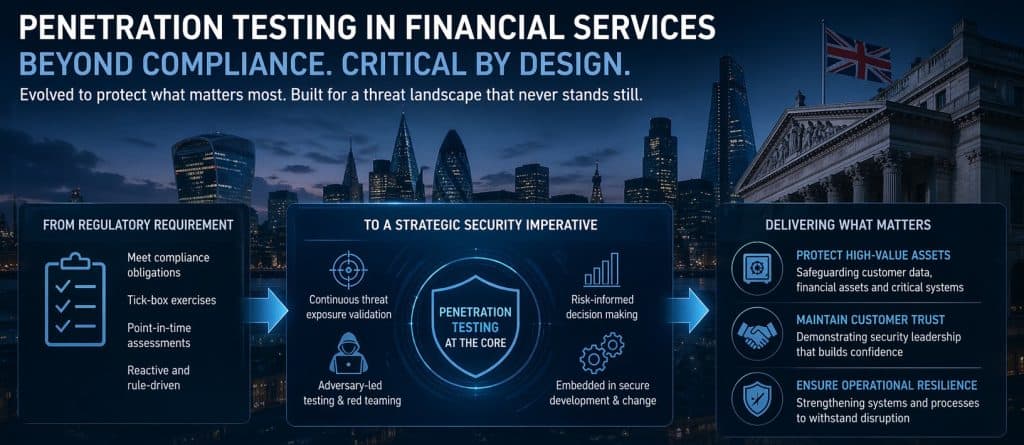
Turning Penetration Testing into a Strategic Advantage
Penetration testing for financial institutions should not sit within IT: it should be embedded within enterprise risk management.
When positioned correctly, it provides a clear view of how cyber threats translate into financial, operational, and regulatory risk.
This shift enables organisations to move beyond reactive security measures and towards proactive resilience. It ensures that testing informs board-level decisions, supports compliance with confidence, and strengthens overall risk posture.
By aligning penetration testing with business objectives, financial institutions can transform it from a technical exercise into a strategic capability that protects both revenue and reputation.
Penetration Testing for Financial Institutions: Strategic Takeaways
To maximise the value of penetration testing:
- Align testing with high-impact financial risks
- Focus on real-world attack simulation, not just compliance
- Ensure reporting translates technical findings into business impact
- Adopt continuous testing rather than annual cycles
- Embed remediation into operational workflows
For guidance on penetration testing and wider cyber security concerns, please contact Akita’s security consultants:
Contact Us