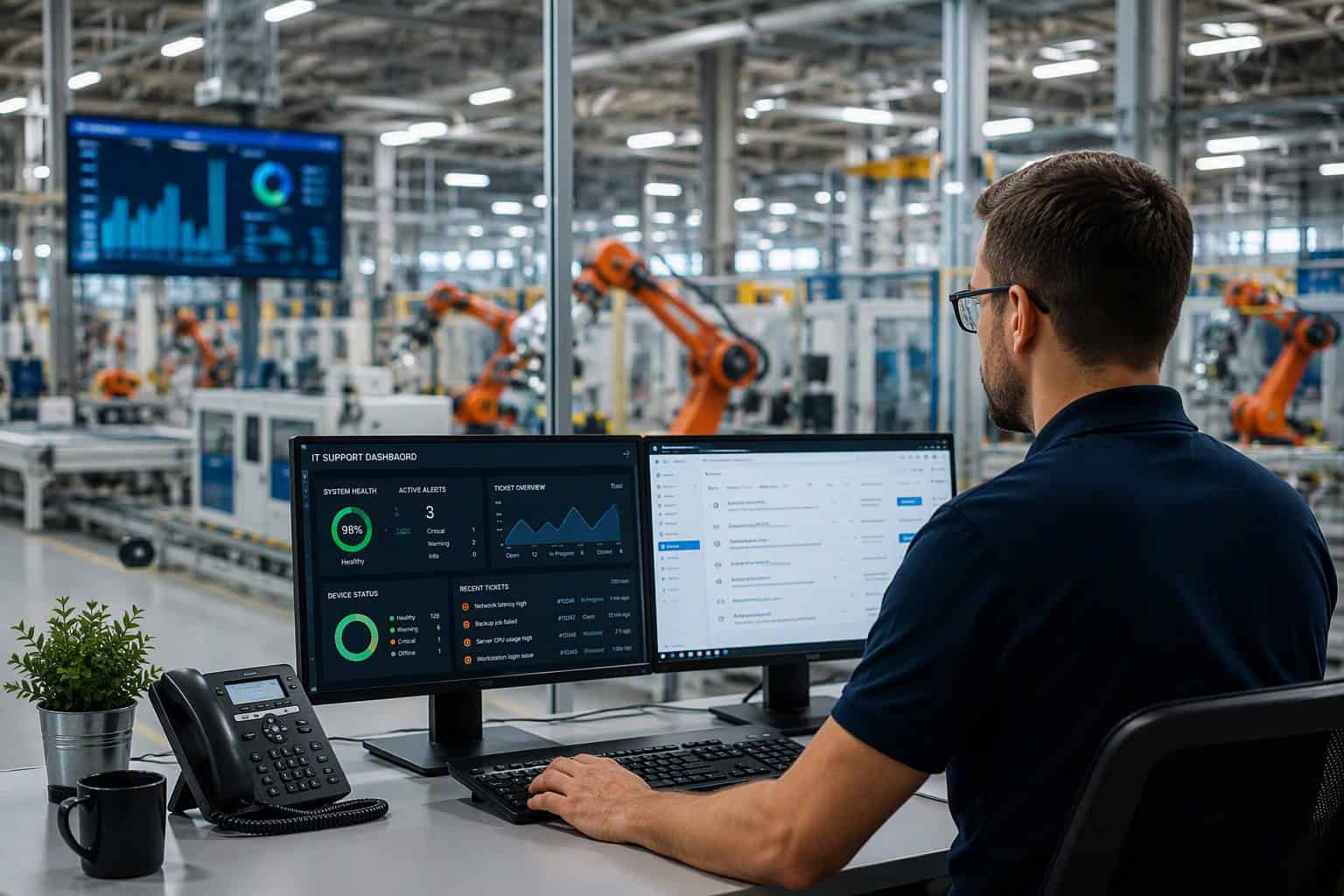
In recent years, the shortage of technology talent for manufacturing has become just as significant as the shortage of engineers, operators and production staff.
As manufacturing businesses embrace cloud platforms, ERP systems, automation, AI and connected supply chains, the demands placed on internal IT teams continue to grow.
At the same time, recruiting and retaining specialists with expertise across infrastructure, cyber security, cloud and business applications is becoming increasingly difficult.
For many, outsourced IT for manufacturers is no longer simply a way to reduce costs. It is becoming a practical solution to skills shortages, increasing technology complexity and the need for round-the-clock operational resilience.
Manufacturing Has Become More Technology-Dependent Than Ever
Modern manufacturing relies on far more than production equipment. Today’s operations depend on interconnected systems that support planning, procurement, inventory management, warehousing, logistics, reporting and customer service.
A single technology issue can have consequences far beyond the IT department. Network outages, cyber incidents, ERP failures or connectivity problems can disrupt production schedules, delay shipments and impact customer commitments.
As manufacturing organisations continue their digital transformation journeys, technology environments are becoming increasingly complex. Many businesses now rely on cloud services, Microsoft 365, ERP platforms, Power BI reporting, automation tools and connected production systems to operate efficiently. These technologies deliver significant benefits, but they also require specialist expertise to manage effectively. Manufacturers are therefore finding themselves dependent on skills that are often difficult and expensive to maintain internally.
The Difficulty Of Recruiting IT Specialists
One of the biggest challenges facing manufacturers today is attracting technology talent.
Competition for experienced IT professionals is intense. Skilled cyber security specialists, cloud architects, ERP consultants and infrastructure engineers are in demand across every sector, from financial services and software companies to large enterprise organisations.
Manufacturers often find themselves competing for the same talent pool without being perceived as technology-first employers. As a result, vacancies can remain open for months, placing additional pressure on existing teams.
Even when successful recruitment takes place, a single hire rarely solves the problem. Modern IT environments require expertise across multiple disciplines. A systems administrator may not have deep cyber security knowledge. An ERP specialist may not be experienced in cloud migration projects. A network engineer may not understand Microsoft 365 governance or compliance requirements.
Building a team that covers every area of expertise can become both costly and unrealistic, particularly for small and mid-sized manufacturing organisations.
This is one of the primary reasons why outsourced IT for manufacturers is becoming increasingly attractive. Rather than relying on a handful of individuals, businesses gain access to a broader range of specialists without the costs and risks associated with constant recruitment.
Maintaining 24/7 Technology Support
Unlike traditional office-based organisations, manufacturing operations rarely fit neatly into a nine-to-five schedule.
Many manufacturers operate shift patterns, extended production hours or even continuous operations. Technology issues do not wait until normal business hours, and downtime during overnight shifts can be just as damaging as disruption during the working day.
Maintaining genuine 24/7 IT coverage internally can be challenging. It often requires multiple engineers, on-call rotas, holiday cover and succession planning. For many businesses, this level of resource is simply not available.
Akita’s manufacturing-focused IT services, proactive monitoring, responsive support and resilient infrastructure help reduce avoidable disruption, while around-the-clock monitoring and support services help manufacturers maintain reliable technology environments.
By partnering with an outsourced IT provider, manufacturers gain access to continuous monitoring and support capabilities without having to build an internal support operation of equivalent scale. This reduces risk while helping ensure production-critical systems remain available when they are needed most.
The Growing Need for ERP, Cloud and Cyber Security Expertise
Technology requirements within manufacturing have evolved dramatically over the past decade.
Many organisations are modernising legacy systems and moving towards integrated platforms that connect finance, purchasing, inventory, warehousing, supply chain management and production operations. Solutions such as Microsoft Dynamics 365 Business Central are helping manufacturers improve visibility and streamline processes through a single technology platform
However, implementing and supporting these systems requires specialist knowledge.
At the same time, cloud adoption continues to accelerate. Hybrid working, remote access requirements and growing data volumes have increased reliance on platforms such as Microsoft Azure and Microsoft 365. Managing these environments effectively involves governance, security, compliance, backup and performance optimisation considerations that many internal teams may not have the resources to address fully.
Cyber security presents an additional challenge. Manufacturers have become increasingly attractive targets for cyber criminals. Ransomware attacks, phishing campaigns, compromised accounts and supply chain attacks can all create significant operational disruption. As operational technology and business systems become more connected, attack surfaces continue to expand.
Akita notes that manufacturing organisations face growing threats from ransomware, device compromise, network intrusion and vulnerabilities associated with connected environments, creating direct risks to uptime, intellectual property and commercial continuity.
Addressing these risks requires expertise spanning threat detection, incident response, vulnerability management, user awareness training, compliance frameworks and security monitoring. Few manufacturers can realistically employ dedicated specialists in each of these areas.
Why Co-Managed IT Is Becoming More Popular
Outsourcing does not necessarily mean replacing an internal IT team. Many manufacturing organisations are adopting co-managed IT models that combine internal knowledge with external expertise.
This approach allows internal teams to focus on supporting employees, managing site-specific requirements and delivering strategic business initiatives, while external specialists provide additional resources, monitoring, cyber security expertise and project delivery capabilities.
Co-managed IT can be particularly valuable for manufacturers that have a small internal IT team supporting a growing organisation. Instead of being overwhelmed by increasing demands, internal staff gain access to specialist resources that complement their existing capabilities.
The result is greater resilience, improved service levels and less dependency on individual employees.
Outsourcing Is Becoming a Strategic Decision
Historically, outsourced IT was often viewed primarily as a cost-saving exercise. Today, the conversation is changing.
Manufacturers are increasingly recognising that technology plays a central role in production efficiency, business resilience and competitive advantage. They need access to skills that are difficult to recruit, support that extends beyond standard business hours, and expertise that spans infrastructure, cloud, ERP platforms and cyber security.
For many organisations, building these capabilities entirely in-house is no longer practical.
That is why outsourced IT for manufacturers is becoming less of a procurement decision and more of a strategic business decision. The goal is not simply to reduce costs. It is to ensure the organisation has access to the technology expertise required to support growth, strengthen security, improve operational visibility and keep production moving.
As manufacturing continues to become more connected and data-driven, the businesses best positioned for success will be those that can bridge the growing IT skills gap before it becomes an operational risk.
Looking For Strategic IT Support For Manufacturing?
Akita helps manufacturers align technology with operational goals through proactive IT support, cyber security services, cloud solutions and Microsoft business applications. Whether you need a fully outsourced service or additional expertise to support your internal team, our specialists can help you build a more resilient and future-ready technology environment.
Contact Us