Without doubt, 2025 was the year when the race for business AI supremacy took hold. Microsoft is entering 2026 with a highly-competitive new version of its existing Copilot offering.
Introducing Microsoft 365 Copilot Business
The launch of Microsoft 365 Copilot Business marks a meaningful step in the evolution of AI-powered productivity for smaller organisations.
After an initial focus on enterprise adoption, Microsoft is now extending Copilot to businesses that rely on Microsoft 365 Business plans: recognition that efficiency, insight and speed are just as critical outside large corporate environments.
This move reflects a broader shift in Microsoft’s strategy. AI is no longer positioned as a specialist capability or experimental add-on, but as a core element of the modern digital workplace. Copilot Business is designed to sit naturally within everyday tools, supporting users in the flow of work rather than introducing new systems to learn or manage.
Understanding The Copilot Business Product & Value
Microsoft 365 Copilot Business is an AI assistant embedded directly across familiar Microsoft 365 applications, including Word, Excel, Outlook, Teams and PowerPoint. It is designed to reduce time spent on manual tasks, surface insights more quickly and support better decision-making across the organisation.
Rather than operating as a standalone chatbot, Copilot draws on context from emails, documents, meetings, chats and calendars to generate relevant, timely outputs. This context-aware approach is central to its value, allowing users to draft content, analyse data or summarise activity without breaking their workflow.
For organisations already invested in Microsoft 365 Business, Copilot Business is positioned as a natural extension of their existing environment. It builds on tools people already trust, reinforcing productivity rather than disrupting established ways of working.
Who Is Microsoft 365 Copilot Business For?
Microsoft 365 Copilot Business is designed specifically for small and medium-sized organisations of up to 300 staff.
It is available as an add-on for customers using Microsoft 365 Business Basic, Business Standard or Business Premium.
With its offering, Microsoft is targeting an audience of organisations that want access to advanced AI capabilities without moving to enterprise licensing. This spans a wide range of sectors, from professional services and construction to manufacturing and the public sector, where teams are often time-poor and under pressure to do more with existing resources.
Crucially, Copilot Business is not a reduced or simplified version of Copilot. At launch, Microsoft has confirmed there is no functional difference between Microsoft 365 Copilot Business and the Copilot offering priced at around £30 per user per month. The distinction lies in eligibility and licensing, not in features or performance.
For many SMBs, this removes a significant barrier to adoption. They can access the same AI-powered productivity tools used by larger enterprises, while remaining on Microsoft 365 Business plans that better suit their size and structure.
Key Features And Capabilities
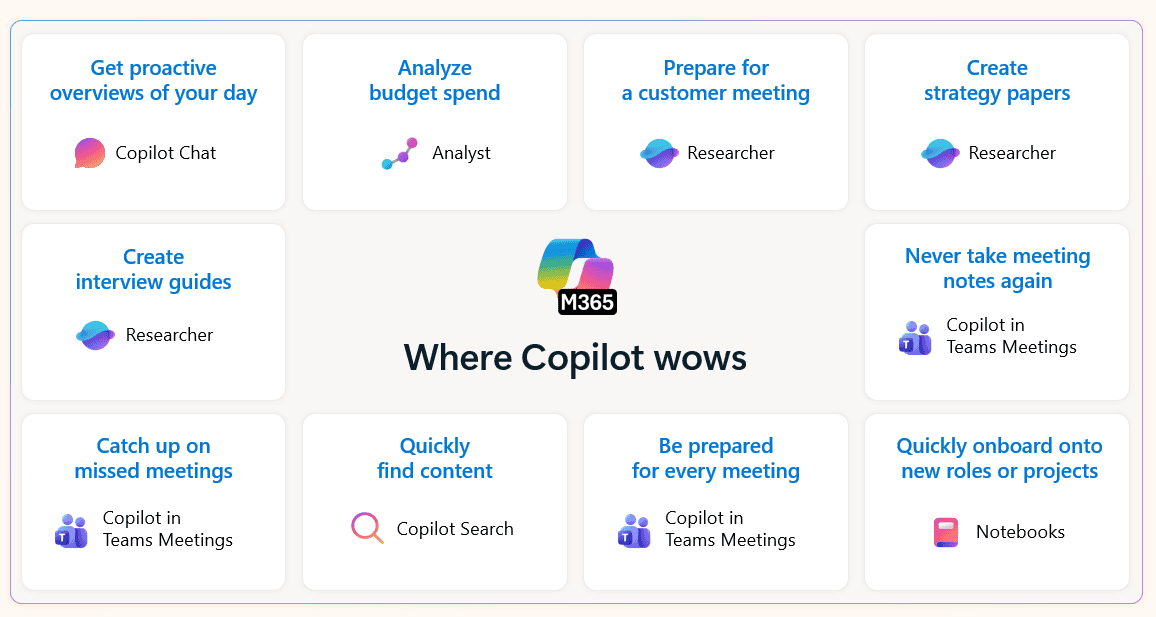
At launch, Microsoft 365 Copilot Business delivers the full Copilot experience across the Microsoft 365 ecosystem. In Word, Copilot supports drafting, rewriting and summarising documents, adjusting tone and structure based on prompts. In Excel, it can analyse datasets, build formulas, identify trends and explain insights in plain language.
Within Outlook, Copilot helps summarise long email threads, draft responses and prioritise messages. In Teams, it can recap meetings, highlight key decisions, identify action points and answer questions based on meeting content, even for those who could not attend.
A defining feature of Copilot is its integration with Microsoft Graph. This allows it to work securely with organisational data while respecting existing permissions and compliance controls. Users only generate insights from data they are already authorised to access, which is particularly important for regulated or security-conscious environments.
approaching the 300-user mark, this makes long-term licensing strategy an important consideration when planning Copilot adoption.
Competitive Pricing And Market Positioning
One of the most notable aspects of the Copilot Business launch is its pricing strategy. By offering the same Copilot capabilities to Business plan customers at a more accessible entry point, Microsoft is actively lowering the barrier to AI adoption across the SMB market.
As a limited offer, Microsoft is offering Copilot Business with Microsoft Business Standard licences for £309.60 per annum ( and with Microsoft Business Premium licences for £397.20 per annum. This amounts to only around £16 per month more per user than without Copilot – money that’s certain to be recouped in efficiency savings.
While Microsoft has indicated that both pricing and product structure may evolve over time, the current positioning is clear: Copilot Business is intended to make AI-driven productivity a standard part of the Microsoft 365 experience.
From a competitive perspective, this approach differentiates Copilot from standalone AI tools. Its value lies not only in what it can generate, but in how seamlessly it integrates into existing workflows, supported by Microsoft’s security, compliance and identity framework.
For decision-makers, the conversation is shifting from whether AI should be adopted to how quickly it can be introduced responsibly, securely and with measurable return.
Licensing, Eligibility And Seat Limits
Eligibility for Microsoft 365 Copilot Business is limited to organisations with Microsoft 365 Business Basic, Standard or Premium licences and a maximum of 300 users per tenant.
Microsoft enforces this through a tenant-wide seat cap across the Business family of plans. Organisations can purchase up to 300 seats in total across Business Basic, Business Standard and Business Premium. Those exceeding this threshold are expected to move to Microsoft 365 enterprise plans.
Interested in Microsoft 365 Copilot Business? Reach out to our Microsoft consultants today:
Contact Us