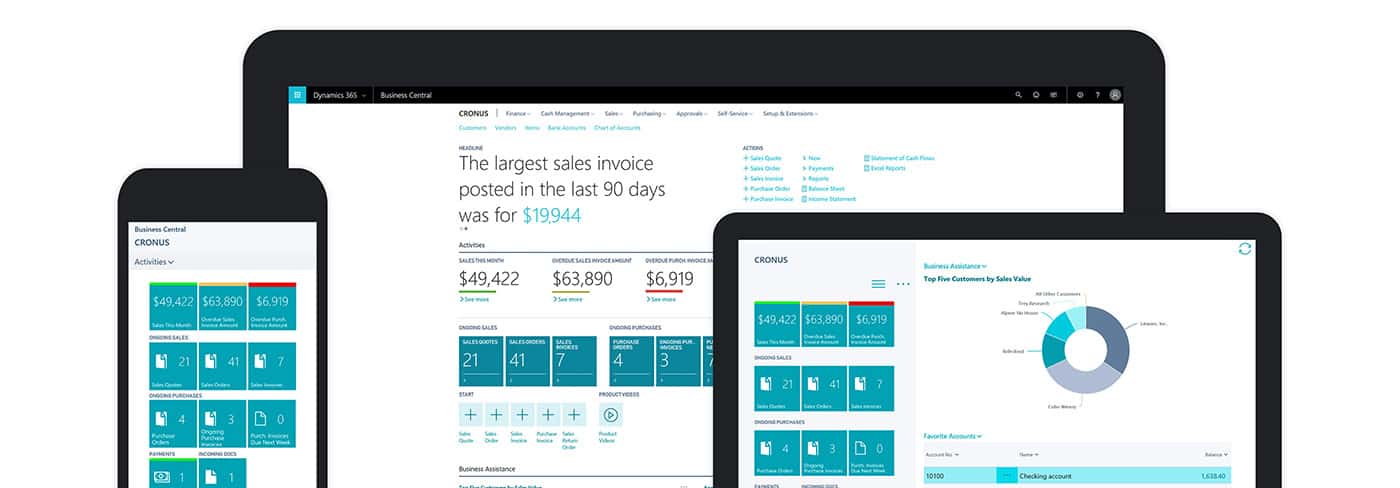
As organisations grow, complexity grows with them. Finance becomes harder to control, reporting takes longer, and operational decisions are increasingly made using incomplete or outdated data. Many leadership teams reach a point where spreadsheets, disconnected systems or entry-level accounting tools no longer provide the visibility or control required to run the business effectively.
This is typically the moment when Enterprise Resource Planning (ERP) enters the conversation. Microsoft Dynamics 365 Business Central is one of the most widely adopted ERP platforms for small and mid-sized organisations, yet many business leaders are asked to approve or sponsor it without a clear understanding of what it actually is, what problems it solves, or why it matters strategically.
This article explains Business Central from a leadership perspective: what it is, why organisations adopt it, and how it supports better decision-making across the business.
What Is Microsoft Dynamics 365 Business Central?
Business Central is Microsoft’s cloud-first ERP platform designed to bring core business operations into a single, integrated system. It connects finance, operations, sales, purchasing, projects and reporting so that data flows through the organisation consistently and in real time.
Unlike traditional accounting software, Business Central does not sit at the end of a process simply recording results. Instead, financial data is created as part of operational activity. Orders, invoices, inventory movements, project costs and service delivery all feed directly into financial and performance reporting.
For leadership teams, this means fewer surprises, more accurate forecasting and a clearer view of how day-to-day activity impacts profitability, cash flow and growth.
Why Organisations Adopt Business Central
Most organisations do not adopt an ERP system because they want new technology. They do so because existing systems are holding them back.
Common triggers include:
-
Limited visibility of financial and operational performance
-
Manual processes that increase cost and risk
-
Difficulty scaling systems alongside business growth
-
Inconsistent reporting across departments
-
Reliance on spreadsheets to bridge system gaps
Business Central addresses these challenges by acting as a single source of truth for the organisation, reducing fragmentation and enabling leadership teams to make decisions based on reliable, up-to-date information.
Core Capabilities At A Glance
Business Central is broad by design, but its capabilities can be summarised into a small number of core areas:
-
Financial management: general ledger, cash flow, budgeting, fixed assets and financial reporting
-
Supply chain and operations: purchasing, inventory, demand planning and supplier management
-
Sales and service: order management, invoicing and customer service processes
-
Project management: cost tracking, revenue recognition and margin control for project-based work
-
Reporting and insight: real-time dashboards and analytics, including Power BI integration
These capabilities are fully integrated, meaning activity in one area automatically updates the rest of the system.
How Business Central Supports Better Leadership Decisions
From a leadership standpoint, the value of Business Central lies less in individual features and more in the quality of insight it enables.
Real-time data replaces retrospective reporting. Financial performance can be reviewed daily rather than monthly. Operational issues can be identified early, before they impact customers or cash flow. Forecasts are based on live data rather than assumptions.
Because Business Central links financial and operational activity, leaders gain a clearer understanding of what is driving results. Margins can be analysed by customer, product, project or service line. Growth can be assessed not just by revenue, but by profitability and capacity.
This level of visibility supports more confident decision-making around investment, resourcing and strategic direction.
Built For Modern, Connected Organisations
Business Central is designed for cloud deployment, providing scalability, security and accessibility without the overhead of on-premises infrastructure. Automatic updates ensure the platform evolves alongside regulatory and market changes, without disruptive upgrade projects.
Integration with Microsoft 365 is a key advantage for leadership teams. Data can be analysed in Excel, approvals managed in Outlook, collaboration handled in Teams and insights visualised through Power BI. This reduces friction between systems and improves adoption across the organisation.
The user experience is role-based, ensuring individuals see information relevant to their responsibilities while leadership retains oversight across the business.
Commercial & Licensing Considerations
Business Central uses a subscription-based licensing model aligned to business roles rather than blanket access. Core users are licensed for full operational functionality, while lighter users can be given limited access for approvals or reporting.
For leadership teams, this provides predictability of cost and flexibility as the organisation grows. It also ensures that system access reflects governance and control requirements.
Business Central As A Platform, Not A System
ERP adoption is as much a business change as a technology one. Business Central often becomes the operational backbone of the organisation, shaping how processes are designed and how data is used.
When implemented effectively, it enables:
-
Faster financial close and improved cash management
-
Reduced operational risk through automation and controls
-
Improved accountability through transparent reporting
-
Stronger foundations for growth and digital transformation
For leadership teams, understanding Business Central is not about learning system screens or technical details. It is about understanding how integrated data, consistent processes and real-time insight can support stronger governance, better performance and sustainable growth.
Business Central is not simply an IT investment. It is a strategic platform that underpins how modern organisations operate, measure success and plan for the future.
To discuss more about Business Central reach out to Akita’s consultants:
Contact Us